


Why is Chefchaouen blue? It is the first question visitors ask when they climb the stairs of this small town in the Rif mountains, where walls, doors and steps are washed in every shade from pale sky to deep cobalt. The honest answer is that nobody knows for sure, and that makes the question even more interesting.
This guide answers the question why is Chefchaouen blue by looking at the four most popular theories, at the history of the town and at what you can do to enjoy it. It is written by a team in Tangier that takes visitors to Chefchaouen every week, so you will also find practical tips on timing, photography and respect. If you are planning the journey, read how to get from Tangier to Chefchaouen first.
Contents
Why is Chefchaouen blue? The short answer
There is no single documented reason. Local people and historians give several explanations, and all of them contain some truth. The town is the Chefchaouen blue city of Morocco, and the colour is now so closely linked with it that it has become part of its identity.
| Theory | What people say |
|---|---|
| Mosquitoes | The blue keeps mosquitoes away |
| Sky and heaven | The blue is a reminder of the sky and of a spiritual life |
| Refugees | Jewish families who arrived in the twentieth century brought the custom |
| Tourism | Some locals say the walls were painted in the 1970s to attract visitors |
You can read more about the town on Wikipedia.
Why is Chefchaouen blue? The four main theories
Theory 1: to keep mosquitoes away
One popular explanation is that the blue paint repels mosquitoes. Lime wash was often mixed with natural pigments, and some people believe that insects avoid the colour. It is a practical idea, but there is no firm evidence for it.
Theory 2: the colour of the sky and of heaven
Another explanation is symbolic: blue stands for the sky, for water and for heaven, and the paint reminds the people of the town to lead a spiritual life. In many cultures blue has a protective meaning, and this theory fits the religious character of the old town.
Theory 3: the legacy of Jewish refugees
A story often told by guides links the colour to Jewish families who settled here, where blue has a spiritual meaning. The town has a Jewish and Andalusian past, but there is no single proven answer on when the walls turned blue, so treat this as a popular tradition and not as a proven fact.
Theory 4: a tourism choice
Some locals say that the walls were ordered to be painted blue in the 1970s to attract visitors, and that the colour has since become a brand. Whatever the origin, today residents repaint their houses regularly, and the blue is a living tradition as much as a tourist draw.
Why is Chefchaouen blue today? Who keeps the walls blue
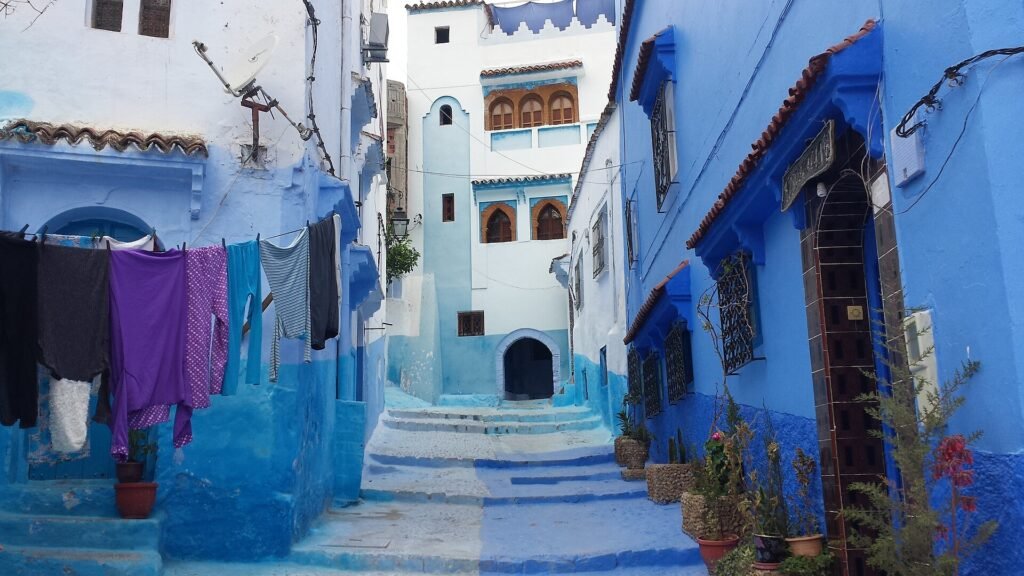
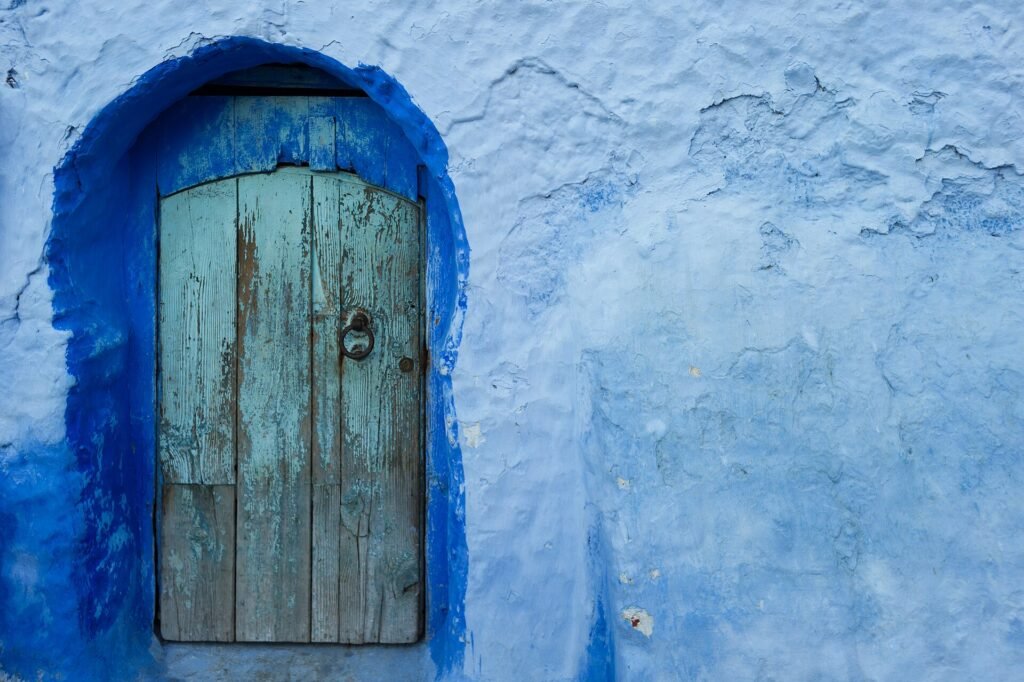
Whatever the origin, the Chefchaouen blue walls are a living practice. Residents and shopkeepers repaint walls, steps and doorframes regularly, and the shades vary from pale sky blue to deep indigo, often in the same lane. You will see blue pots, blue stairs and even blue cats’ bowls, because the colour has spread from the walls to the small details.
Blue is not unique to Chefchaouen: you can find touches of it in Asilah and in the medina of Tangier, and white towns across southern Spain share a taste for whitewash and bright accents. But in no other place has the blue become the whole town. If you have seen our guide to the Tetouan medina, you will recognise the same mix of Andalusian and local influences.
The history behind the blue walls of Chefchaouen
Chefchaouen was founded in 1471 as a small kasbah by Ali ibn Rashid al-Alami, to defend the region against Portuguese attacks. Refugees from Andalusia, both Muslims and Jews, settled here during and after the Spanish Reconquista, and they gave the town its Andalusian architecture, with curved brick arches and a network of fountains.
The name itself is a clue to the setting: it is said to come from an Arabic word meaning look and a Berber word for the horns of the mountains, so that Chefchaouen means look at the horns, a reference to the two peaks above the town. The blue was added much later, and it makes the old stones of the medina look lighter in the sun.
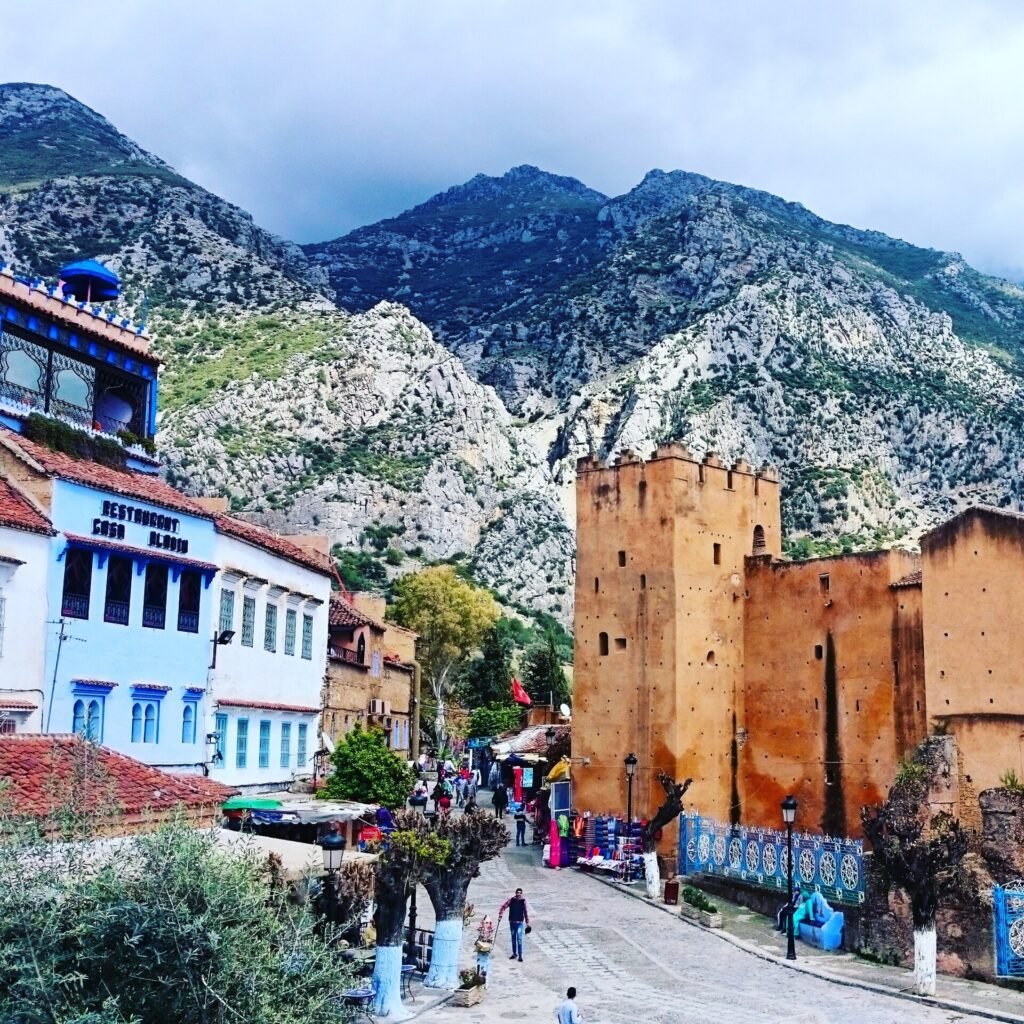
Why is Chefchaouen blue? What to see in the blue city of Morocco
- Plaza Uta el-Hammam: the main square, with the kasbah and the great mosque.
- The medina: the blue and white lanes, best explored without a map.
- Ras el-Maa: the spring and the river at the edge of the old town.
- The Spanish Mosque: a hill about half an hour from the centre, with the best view at sunset.
- Small squares and fountains: tiled fountains and quiet corners away from the main streets.
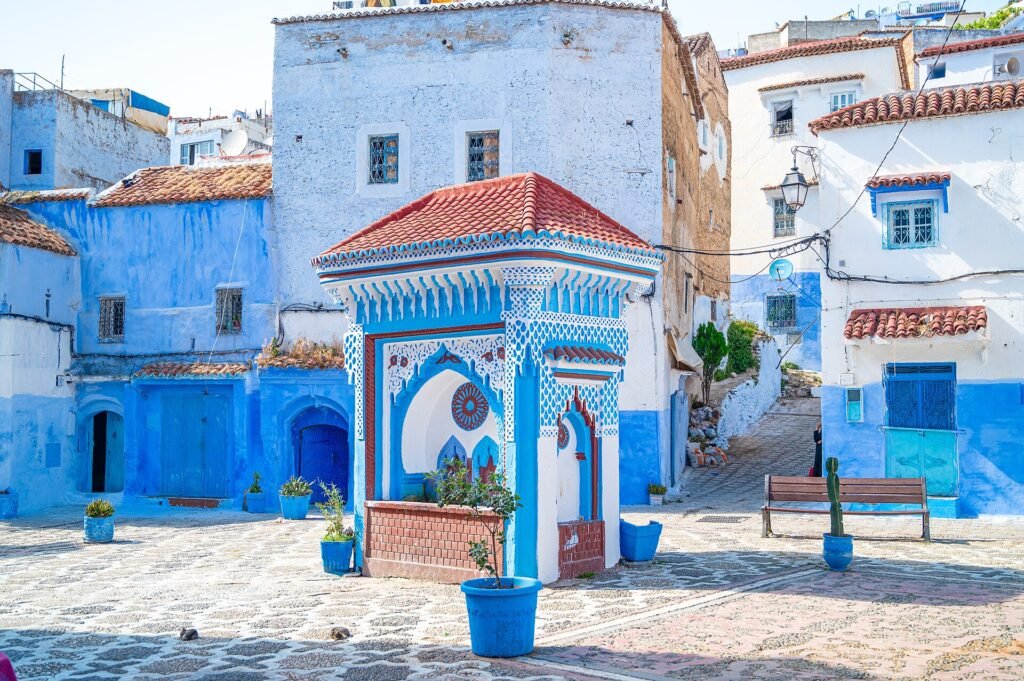
Our guide on the journey from Tangier to Chefchaouen plans a full day in the town and the options for getting there.
Why is Chefchaouen blue? How to photograph the blue walls
- Go early: the light is soft and the alleys are empty before ten.
- Return late: the afternoon sun warms the blue and creates long shadows.
- Look for details: a pot of flowers, a door knocker, a cat on a step.
- Ask before photographing people, and do not enter private houses.
- Do not climb walls or block narrow lanes for a better angle.
For good manners in general, read our guide to Moroccan culture and etiquette.
Why is Chefchaouen blue? What else to know before you go
The blue is only part of the story. The town is also known for its goat cheese, its wool weaving and its relaxed pace, and it sits at the gate of the Rif mountains, with walks that start almost from the old town. Learn about the landscape on Wikipedia.
For one day, the plan is simple: the main square, the kasbah, an hour in the lanes, lunch and the view from the Spanish Mosque. For a better feel for the place, spend a night, because the town is quiet at dawn and after sunset. Official tourism information is available at Visit Morocco.
Plan your visit to the blue city
Now that you know why Chefchaouen is blue, plan your visit. Chefchaouen is about 120 kilometres and two and a half hours from Tangier, so a day trip is easy. Many visitors prefer to spend a night to see the town early and late. If you have more time, add the waterfalls of Akchour, described in our Akchour waterfalls hike guide, or the Andalusian medina of Tetouan.
Trips that fit this
- Chefchaouen Day Trip from Tangier is the simplest way to see the blue city in a day.
- Chefchaouen & Tetouan Day Trip adds the Andalusian city on the way.
- Chefchaouen & Akchour Waterfalls Day Trip combines the blue streets with the river in the mountains.
The page about Chefchaouen tours lists all our trips, and the guide to a northern Morocco itinerary places Chefchaouen on a longer route.
Frequently asked questions: why is Chefchaouen blue?
Why is Chefchaouen blue?
There is no single proven reason. The most common explanations are that the blue repels mosquitoes, that it symbolises the sky and heaven, that it came with Jewish refugees, or that it was encouraged to attract visitors.
Why is Chefchaouen blue and not white like other Moroccan towns?
Many Moroccan towns are white, and Chefchaouen added blue, whether for practical, symbolic or tourist reasons. The result is a town where blue and white are painted together.
When did Chefchaouen become blue?
The date is uncertain. The town was founded in 1471, and the blue is a later tradition, with the widespread painting becoming famous in the twentieth century.
Who paints the walls of the blue city?
The residents themselves, who repaint their houses and steps regularly, so the colour is a living tradition and not a fixed monument.
Is the whole of Chefchaouen blue?
The old town, the medina, is mostly blue and white. The newer parts of the town are not painted in the same way.
What does Chefchaouen mean?
The name is said to mean look at the horns, a reference to the two mountain peaks above the town.
When is the best time to see the blue walls?
Early in the morning, when the lanes are empty, and late in the afternoon for warm light. Spring and autumn are pleasant seasons.
How far is the blue city from Tangier?
About 120 kilometres, or two and a half hours by road. A day trip is possible, and a night in the town is better.
So, why is Chefchaouen blue? Perhaps for all the reasons at once: a practical choice, a symbol of the sky, a tradition that arrived with refugees and a colour that visitors came to love. Go early, walk slowly and let the blue answer for itself.
See the blue city with a local driver
Our Chefchaouen day trip from Tangier leaves in the morning and returns in the evening, with time to walk the blue lanes.
Photos: Allenfleming / Wikimedia Commons, CC BY-SA 4.0 · Randy Tarampi randytarampi / Wikimedia Commons, CC0 · Nabilchatt / Wikimedia Commons, CC BY-SA 4.0 · Badr Rachadi / Wikimedia Commons, CC BY-SA 4.0